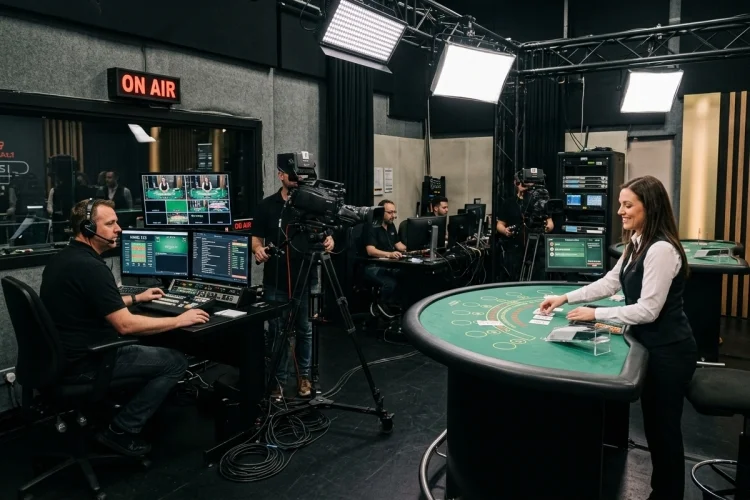




Two blackjack tables can use the same cards, the same green felt, and the same basic objective while offering noticeably different mathematics. The reason is hidden in the rules.
Asking What Is the House Edge in Blackjack? therefore requires more than quoting one percentage.
Blackjack’s casino advantage changes according to payouts, dealer procedures, deck count, doubling options, splitting rules, surrender, and how accurately the player follows basic strategy.
Some adjustments move the edge only slightly, while others make a surprisingly large difference. Understanding them makes comparing blackjack tables much easier.
Start With the Meaning of House Edge
House edge represents the casino’s expected long-term advantage relative to the player’s initial wager.
It is not a prediction for one session.
If a theoretical game has a 1% house edge, the casino would expect to retain around $1 for every $100 of initial wagering over a sufficiently large sample.
That does not mean a player betting $100 will necessarily finish with $99.
Short-term outcomes can vary enormously because cards are random and blackjack includes doubles, splits, natural blackjacks, and pushes.
The UK Gambling Commission describes house edge as a measure of what the casino expects to retain on average under normal play.
The word average is doing a lot of work there.
The Best Blackjack Rules Can Keep the Edge Relatively Small
Blackjack has a reputation for offering relatively competitive casino odds because correct player decisions can reduce the operator’s advantage.
But there is no universal percentage.
Wizard of Odds’ house edge calculator includes thousands of combinations created by changing factors such as number of decks, soft-17 procedure, surrender, splitting, doubling, and blackjack payout.
One common European ruleset – six decks, dealer standing on soft 17, doubling on 9–11, double after split, and no dealer peek – has a calculated house edge of about 0.62% when the correct strategy is followed.
Change those rules, and the edge changes.
That is why “blackjack has a 0.5% edge” should be treated as a rough example, not a universal fact.
3:2 vs 6:5 Is a Major Difference
If you check only one rule, make it the blackjack payout.
At a 3:2 table, a $20 natural blackjack produces $30 profit.
At 6:5, the same hand earns only $24.
You are giving up $6 on that particular result.
Wizard of Odds calculates that replacing 3:2 with 6:5 reduces player return by roughly 1.39 percentage points under its standard baseline rules.
That is a large shift in blackjack terms.
A table can advertise single-deck play, polished live dealers, or exciting side bets, but a 6:5 natural-blackjack payout can materially worsen the main game’s mathematics.
This is why experienced players often look for “Blackjack Pays 3:2” before checking smaller details.
Dealer Hits Soft 17 Adds to the Edge
Soft 17 means a dealer hand such as Ace-6, where the Ace counts as 11.
If the dealer stands on soft 17, the rule is called S17.
If the dealer must hit, it is H17.
H17 is less favourable to the player.
Wizard of Odds estimates a roughly 0.22-percentage-point reduction in player return when the dealer hits soft 17 rather than stands, assuming the other comparison rules remain constant.
That might not sound dramatic.
But blackjack edges can already be below 1%, so a change of two-tenths of a percentage point is meaningful.
It is also a perfect example of why tiny wording in the rules panel can matter more than the visual presentation of the table.
Double After Split Is More Valuable Than It Looks
Suppose you split a pair and receive a strong two-card hand such as 11 on one of the new hands.
If double after split, or DAS, is permitted, you can increase the wager when the mathematical situation is favourable.
Without DAS, that option disappears.
Wizard of Odds estimates that prohibiting double after split costs the player approximately 0.14 percentage points relative to allowing it under the comparison baseline.
Doubling restrictions elsewhere have an effect too.
Limiting doubles to hard totals of 9–11 instead of allowing them on any first two cards costs roughly another 0.09 percentage points.
Neither rule creates a dramatic difference alone.
Stack several restrictive rules together, however, and the final house advantage can become noticably larger.
European No-Hole-Card Rules Can Increase Risk
American-style games commonly allow the dealer to check for blackjack when showing an Ace or ten-value card before players make additional bets.
Traditional European No Hole Card, or ENHC, games may allow players to split or double before discovering that the dealer has blackjack.
In full-loss versions, the extra wagers can be lost too.
Wizard of Odds estimates that traditional ENHC rules reduce player return by around 0.11 percentage points relative to a comparable peek structure.
Some no-hole-card games use Original Bets Only rules that protect extra split or double wagers when the dealer eventually has blackjack.
That can materially change the effect.
This is another reason the title of the game is not enough.
Read how the dealer actually handles blackjack.
Fewer Decks Usually Help – All Else Equal
Many players instinctively look for single-deck blackjack.
There is mathematical logic behind that preference.
Wizard of Odds estimates that moving from its eight-deck baseline to single-deck play improves player return by about 0.48 percentage points, assuming the rest of the rules remain identical.
But casinos do not always keep everything else identical.
A single-deck game may compensate with a 6:5 payout, H17, or less flexible doubling.
Those disadvantages can outweigh the benefit of fewer decks.
So “single deck” should never be treated as shorthand for “lower house edge.”
The complete ruleset still decides the outcome.
Surrender Can Slightly Improve Player Return
Late surrender allows a player to give up certain weak starting hands and lose only half of the original wager.
That may sound like admitting defeat, but mathematically it can be valuable.
Wizard of Odds lists late surrender as improving player return by around 0.08 percentage points under its standard comparison.
The practical value is that some hands have such poor prospects against strong dealer up-cards that losing half a bet is preferable to playing the whole hand.
Not every table offers surrender.
When comparing two otherwise similar games, its availability is another small rule worth checking.
Blackjack’s edge is often created by the accumulation of many details like this.
Basic Strategy Is Part of the House-Edge Calculation
Rule quality matters, but player decisions matter too.
House-edge figures for blackjack are generally calculated assuming optimal or near-optimal strategy.
If a player repeatedly makes poor decisions, their personal expected loss can be higher than the published mathematical edge.
For example, taking insurance without a specific mathematical reason, standing on weak totals in the wrong situations, or refusing favourable doubles can increase expected losses.
Basic strategy does not involve guessing which card will appear next.
It simply compares the expected values of hit, stand, double, split, and surrender based on the known cards and rules.
The correct chart also changes between rulesets, which is why using one generic strategy for every blackjack table can be matematically inaccurate.
Side Bets Should Be Evaluated Separately
A table can have an excellent main-game house edge while offering optional wagers with much larger casino advantages.
Insurance is a familiar example.
Wizard of Odds calculates a house edge of about 5.9% on insurance in a single-deck game based on the normal card composition.
Other side wagers such as Perfect Pairs or poker-style combinations use entirely different probability and payout structures.
Do not average them mentally into the main game.
If you wager $10 on blackjack and another $5 on a side bet, you are effectively participating in two mathematical propositions at the same time.
Each should be evaluated on its own rules.
How to Compare Blackjack Tables Quickly
You do not need to calculate thousands of combinations manually.
Start by checking the natural blackjack payout. Prefer 3:2 over 6:5 when other conditions are comparable.
Then check whether the dealer stands or hits soft 17, whether double after split is allowed, the deck count, surrender availability, and any special hole-card rules.
Regulated online games should make relevant rules and information about house edge, RTP, or probabilities accessible before customers commit to gamble.
That makes the help screen one of the most useful parts of a blackjack game.
Ignore it, and two visually identical tables can hide very differnt mathematics.
So, What Is the House Edge in Blackjack? It is not one fixed percentage but the combined result of rules and player strategy. A 3:2 payout, S17, flexible doubling, DAS, surrender, and favourable deck conditions can all improve expected return.
Before choosing a table, compare its rules rather than its graphics or minimum bet. Small percentage changes may look minor, but over long-term play they genuinely matter.